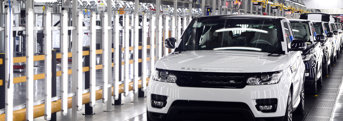
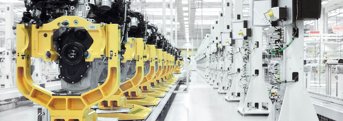
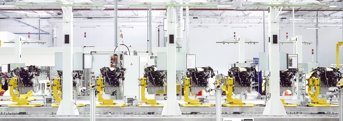
Delivering a state-of-the-art manufacturing facility to a demanding programme.
We played a key role in the delivery of the £450m i54 Engineering Plant for Jaguar Land Rover, a new engine manufacturing facility developed to support increased production capacity and future growth.
Working alongside Vinci and ARUP, the project required the design, manufacture and installation of mechanical services within a large-scale industrial environment, delivered to a highly compressed programme to enable timely commencement of engine production.
The scale of the facility, combined with programme demands and structural constraints, required a coordinated and production-led approach to ensure installation could be completed efficiently while maintaining quality and safety standards.
Maximising offsite manufacturing to support high-volume installation
The delivery strategy centred on maximising the use of offsite manufacturing for high-level services within the manufacturing halls and rooftop plant areas.
In total, 67 heavy-duty service modules were delivered alongside 1,294 loose welded pipe spools, supported by approximately 4,880 metres of secondary steelwork bracketry and over 4,500 prefabricated brackets. In excess of 2,600 metres of services were installed across the facility.
Modules were manufactured offsite using carbon steel pipework systems and designed to enable efficient installation and connection on site. This approach removed over 7,300 man hours from site activities, significantly reducing labour intensity within the construction environment.
To address structural loading constraints on the roof and purlins, nearly 5km of secondary steelwork was installed to span the primary structure. Rooftop modules were designed using adjustable Sikla support systems, allowing flexibility during installation and ensuring alignment with structural limitations.
Improving safety, productivity and programme certainty through industrialised delivery
The use of offsite manufacturing enabled a reduction in high-risk activities, eliminating the majority of hot works on site and significantly reducing working at height.
Manufacturing in a controlled environment improved quality and consistency, with prefabricated systems delivered ready for installation, reducing defects and rework. All modules were delivered directly to site in line with installation sequencing, supporting efficient logistics and minimising storage requirements.
The approach enabled a high rate of installation aligned to programme demands, ensuring the facility was delivered on time to support production targets. The project was completed with zero accidents, reinforcing the safety benefits of an offsite-led delivery model.