Supporting the UK’s transition to electrification through advanced manufacturing infrastructure
NG Bailey delivered the mechanical and electrical installation for the UK Battery Industrialisation Centre (UKBIC) in Coventry, a nationally significant facility developed as part of the UK Government’s Faraday Battery Challenge.
Working as Principal Contractor, NG Bailey supported the creation of a state-of-the-art centre of excellence designed to accelerate the development, scale-up and commercialisation of next-generation battery technologies. The facility provides a unique environment for manufacturing, testing and innovation across the full battery production lifecycle.
Delivering complex MEP infrastructure within a compressed programme
NG Bailey was responsible for delivering a £14.6m M&E installation within an accelerated eight-month programme.
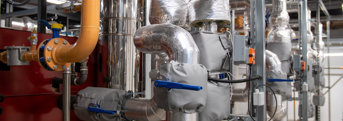
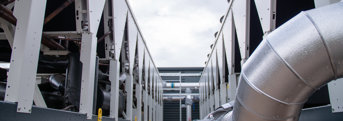
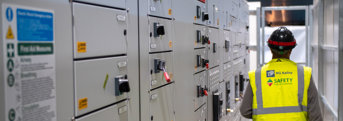
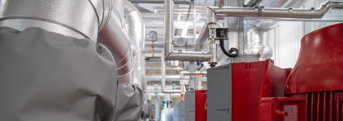
The scope included the manufacture and installation of complex mechanical and electrical infrastructure, including pipework systems, distribution systems, air handling units, plant skids and specialist service installations required to support advanced manufacturing processes.
Following completion of the core M&E works, NG Bailey was retained as Principal Contractor to support the installation of specialist process equipment, reinforcing its role in enabling the facility’s operational readiness.
Using offsite manufacturing to drive programme, safety and innovation
To meet the demanding programme, NG Bailey adopted an offsite-led delivery model, engaging early to develop engineered solutions that maximised efficiency and buildability.
Over 6km of pipework and 140 heavy-duty multi-service modules were prefabricated offsite, alongside:
Six plant skids supporting LTHW and CHW systems
Multi-service trench modules for mechanical and electrical services
Bespoke floor-standing service modules and gantry structures
Air handling unit valve assemblies and distribution board assemblies
Extensive prefabricated bracketry and spool systems.
In total, this approach removed approximately 17,000 labour hours from site, significantly reducing congestion, improving safety and enabling parallel installation activities.
A key innovation was the development of a 20m long, 5m high multi-service bridge, designed to house essential services while minimising spatial impact and maximising usable production space within the facility.
Enhancing quality, safety and operational performance through engineered delivery
Manufacturing in a controlled environment ensured high levels of quality and consistency, while reducing the need for high-risk site activities such as hot works.
The offsite approach also delivered measurable improvements in site logistics and safety performance, contributing to the successful delivery of the project with zero RIDDOR incidents across approximately 150,000 labour hours.
Beyond delivery, the project also supported skills development, with apprentices and work experience placements contributing to the build, aligning with the wider objectives of innovation, education and industry growth.