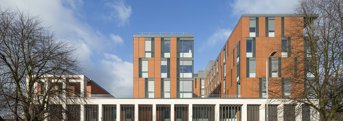
Setting a new benchmark for low-carbon healthcare education through Passivhaus design and advanced engineering
At the University of Leicester, the Centre for Medicine represents a step-change in how large-scale education buildings can be designed, delivered and operated to minimise energy demand and carbon impact.
As one of the largest non-residential Passivhaus buildings in the UK, the development was conceived as a flagship for sustainable design, combining ultra-low energy principles with high-quality teaching and research environments. The brief set ambitious targets, including Passivhaus certification, BREEAM Excellent and an EPC A rating, while also aiming to achieve a Display Energy Certificate (DEC) A rating in operation.
NG Bailey was responsible for taking the mechanical and electrical design from developed concept through to full construction, delivering an integrated building services solution that supports both the functional demands of a modern medical facility and the University’s long-term decarbonisation strategy.
The result is a highly efficient, future-ready building that now acts as a central hub for teaching, research and collaboration, supporting lecture theatres, flexible learning spaces, academic offices and specialist facilities within a carefully controlled internal environment.
Minimising energy demand through Passivhaus design and intelligent building systems
At the core of the project is a fabric-first, Passivhaus-led approach, reducing energy demand as far as possible before introducing low and zero carbon technologies.
The building envelope was designed to significantly exceed regulatory requirements, incorporating triple glazing, high-performance insulation and a thermal bridge-free construction. This delivers exceptional airtightness, achieving air permeability of less than 1 m³/hr/m² @ 50 Pa, and dramatically reducing heat loss.
A hybrid ventilation strategy plays a key role in maintaining comfort while minimising energy use. During colder months, mechanical ventilation systems with high-efficiency heat recovery ensure fresh air is supplied with minimal heat loss. In warmer periods, natural ventilation is used where appropriate, reducing reliance on mechanical systems.
To further optimise performance, a ground-to-air heat exchange system pre-heats incoming air by up to 7°C in winter and pre-cools it by up to 8°C in summer, significantly reducing the energy required for conditioning fresh air. This is complemented by high-efficiency thermal wheel heat recovery and ultra-low energy fan systems, achieving a specific fan power as low as 1.6 W/l/s.
The building’s structure also contributes to its performance. A heavyweight concrete frame with exposed soffits absorbs heat gains during the day, while night-time purge ventilation removes stored heat, reducing the need for active cooling. Elevated chilled water temperatures further increase opportunities for free cooling, minimising reliance on energy-intensive systems.
Heating is provided via a district heating network utilising CHP waste heat, ensuring efficient use of energy at a wider system level, while variable volume controls across air and water systems ensure that energy use closely matches actual demand at all times.
A fully integrated Building Management System (BMS) underpins the building’s performance, providing detailed energy monitoring, system optimisation and individual space control, enabling continuous performance improvement throughout operation.
To further support decarbonisation, the building incorporates 150m² of photovoltaic panels, generating renewable electricity on site and reducing overall carbon intensity.
Delivering performance through collaboration and soft landings
Achieving this level of performance required a highly collaborative approach across design, construction and operation. We implemented a full soft landings process, supporting the transition from construction to operation and ensuring that building performance aligned with design intent.
This extended beyond completion, with continued engagement to support system optimisation and user understanding, a critical factor in achieving real-world energy performance.
The building successfully achieved Passivhaus certification, BREEAM Excellent and an EPC A rating, and went on to achieve a DEC A rating within two years of operation, demonstrating that the design intent translated into measurable in-use performance