


Supporting the delivery of a major academic and research facility at campus scale
We contributed to the delivery of the University of Manchester’s £350m engineering campus development, the largest construction project ever undertaken by the University.
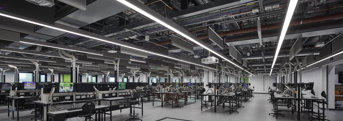
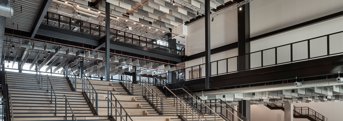
The scheme brings together four engineering schools and two research institutes within the Faculty of Engineering and Physical Sciences, delivered through a combination of new build and refurbishment across an existing city centre campus.
In total, approximately 78,000m² of space has been reconfigured and redeveloped, creating a modern, integrated environment supporting 1,300 academics, researchers and staff, alongside 6,750 students. The scale and complexity of the project, combined with its location within a live university campus, required a carefully coordinated approach to design, logistics and delivery.
Using offsite manufacturing to enable delivery at scale within a constrained urban site
Given the scale of the main building, the extent of roof-mounted plant and the constraints of a congested city centre location, offsite manufacturing formed a central part of the delivery strategy.
A wide range of prefabricated solutions were developed, including plant rooms, packaged skids and pipe modules, enabling significant portions of the works to be manufactured and assembled off site. This approach improved quality, reduced on-site labour and supported a more efficient installation process within restricted working areas.
To support installation, local logistics hubs were used to store modules prior to delivery, enabling a just-in-time delivery strategy that reduced site congestion and improved coordination. Complex logistics planning, including road closures and night-time working, was implemented to facilitate safe and efficient installation within the live campus environment.
Driving commercial value and programme certainty through early collaboration
Early engagement during the PCSA phase enabled a transparent and collaborative approach to cost management and design development. Technical Quality Assessment (TQA) sheets were produced for all major suppliers and subcontractors, providing detailed visibility of supply chain pricing and enabling informed decision-making alongside the client.
This structured approach supported effective value engineering, delivering approximately £8.5m in savings while maintaining design intent and performance requirements. The ability to align cost, design and delivery from an early stage contributed to programme certainty and reduced commercial risk across the project.
Delivering a modern, integrated environment for engineering and research
The completed development provides a state-of-the-art environment for teaching, research and collaboration, bringing together multiple disciplines within a single, integrated campus.
By combining large-scale delivery, offsite manufacturing and collaborative project planning, the scheme demonstrates an approach that supports efficient construction within constrained urban environments while delivering long-term value for academic institutions and their stakeholders.